
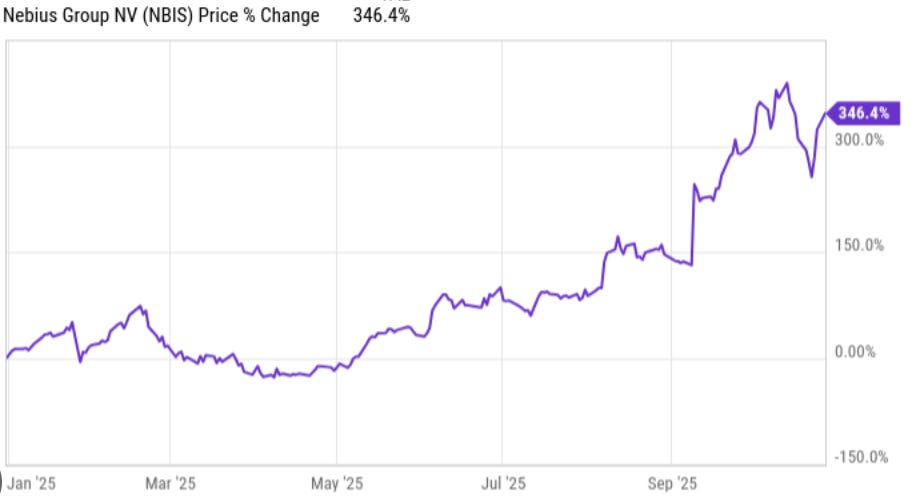
Why I'm Not Selling a Single Share of Nebius after 300% run up
I bought Nebius at $70. The stock has tripled. Here’s why I think the real story is just getting started.


The easy money is gone. Below $100 was a generational re-rating.
But the real question isn’t should I have bought. It’s: does the risk-reward still work at $220 → and where could this go by 2029?
After weeks of modeling, speaking directly with the CCO, and stress-testing every assumption, my answer is yes. Not because of last quarter. Because of what’s coming over the next 2–3 years.
The Vera Rubin Cycle Changes Everything
Most of the Street is still modeling Nebius off its current GPU fleet. That’s yesterday’s hardware.
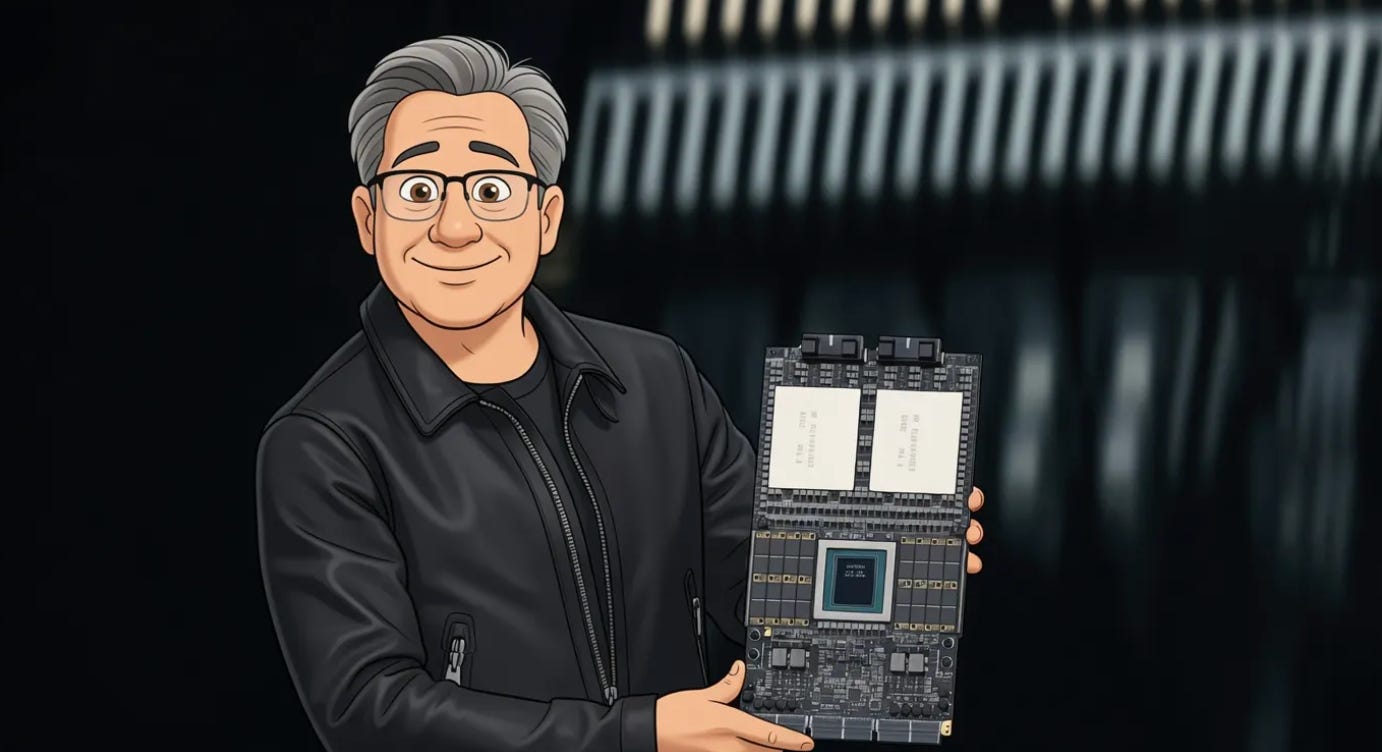
Starting H2 2026, Nebius becomes one of the first cloud providers to deploy NVIDIA’s Vera Rubin NVL72 → 5x greater inference performance, 10x lower cost per token versus Blackwell. Not incremental. Generational.
First-mover access means pricing power. Enterprises pay a premium to get there first and as an NVIDIA Exemplar Cloud Partner with a $2B strategic investment from Huang himself, Nebius has allocation priority its competitors don’t.
Most 12-month price targets aren’t even reflecting it.
Token Factory: Where the Real Margins Live
Here’s where most investors make a mistake with neoclouds → they model them as GPU rental businesses.
Token Factory flips that model.
Nebius’s in-house engineering (custom racks, proprietary cooling, optimized networking) extracts more performance per watt than generic cloud, creating a software-enabled margin layer on top of the hardware.
As Token Factory scales on Vera Rubin through 2027–2028, the revenue mix shifts toward higher-margin inference.
Q1 2026 already showed this working: AI cloud adjusted EBITDA margin hit 45%, nearly doubling quarter-over-quarter.
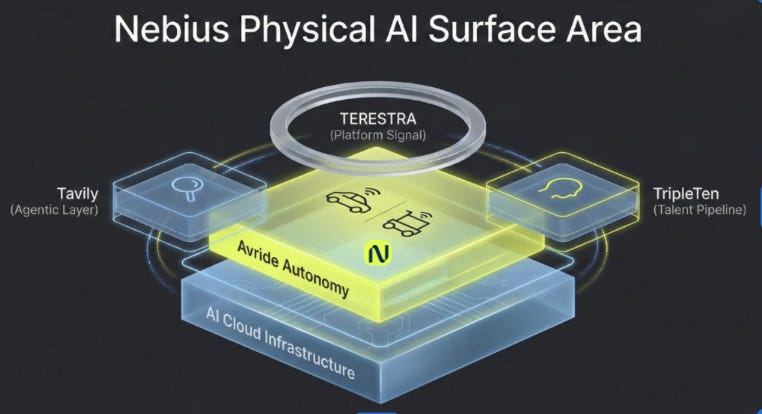
Agentic AI: The Compute Multiplier You Need to Understand
One number reframes this entire thesis.
A chatbot query is one prompt in, one response out. An agentic AI workflow, where autonomous agents plan, reason, call APIs, coordinate, and self-correct across multiple steps, consumes 10–100x more compute per task.
These workloads are projected to represent 38% of all AI inference demand by 2028. The agentic AI market itself is forecast to grow from ~$7B today to $150–200B by 2030–2034.
And every single agent needs GPU infrastructure running continuously, on the latest silicon available. Nebius is building directly into this wave.

The Capacity Math: From 170 MW to 4+ GW
This is where the thesis converts into revenue and the scale is hard to overstate.
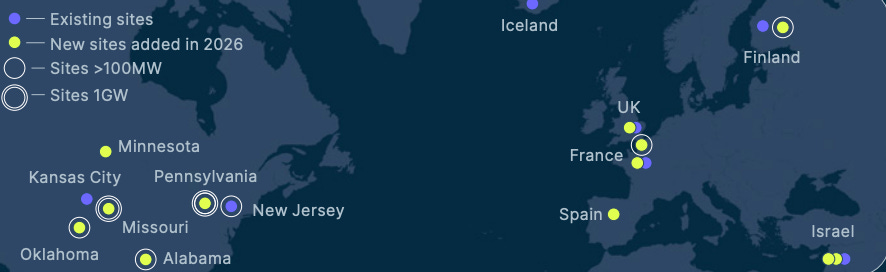
Year-end 2025: ~170 MW connected capacity. Current target: 4+ GW contracted power, with a path to 5 GW by 2030.
That’s a 23x increase in four years.
What’s actively being built:
Pennsylvania → 1.2 GW AI factory, 250–300 MW targeted by year-end 2026
Missouri → Gigawatt-scale site, broke ground, 2027 server deployments
Bloom Energy deal → $2.6B, 10-year partnership: 328 MW of on-site fuel cells replacing gas turbines, operational this year. Behind-the-meter power that bypasses the grid entirely, while competitors wait 3–5 years for grid interconnection
Finland → existing facility, expanding
The critical benchmark: 1 GW of active AI compute capacity supports roughly $4–6 billion in annual revenue at current pricing and utilization. Do that math against the 2028–2029 capacity targets and you start to see where the revenue numbers go.
The Meta Backstop: Still the Most Underpriced Feature
One structural detail that changes the entire risk profile of every dollar Nebius spends on CapEx
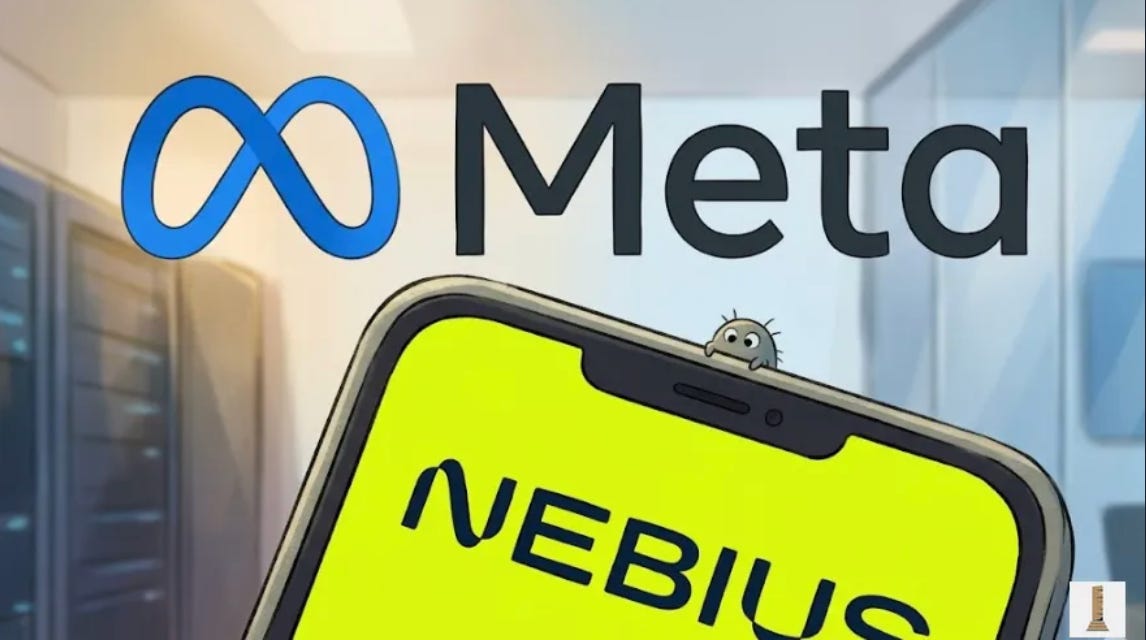
Meta’s $27B deal has two parts: ~$12B in dedicated Vera Rubin infrastructure (online early 2027), and a backstop → If Nebius builds it and nobody else buys, Meta takes it. Demand risk for the entire CapEx pipeline is structurally eliminated.
No other neocloud has this. CoreWeave’s $67B backlog is large - but if demand softens, they absorb the excess.
Combined with Microsoft (~$19.4B), that’s ~$50B in contracted backlog and pipeline excluding hyperscaler deals grew 3.5x quarter-over-quarter.
Where Could This Go? A 2028–2029 Scenario Framework
Nobody can predict prices. But we can build frameworks — and the math here is worth your time.
Key inputs:
2026 guided revenue: $3.0–3.4B | ARR target: $7–9B by year-end
2027 consensus revenue: ~$9–10B
2028 consensus revenue: ~$15–17B (limited analyst coverage)
Management EBITDA margin target: ~40%, with upside as enterprise mix grows
Revenue per GW: ~$4–6B annually at full utilization
Bear Case — “Execution stumbles”
Revenue ~$12–14B by 2028. Margins stall at ~35%. Market de-rates neoclouds. Enterprise diversification slower than expected.
EV/EBITDA: 12–15x → Implied ~$200–300/share
Roughly flat from here. The “it’s priced in” outcome.
Base Case — “Plan meets execution”
Revenue ~$15–18B. EBITDA margins 40–45%. Vera Rubin economics and Token Factory scale. Backlog converts on schedule. Customer base broadens.
EV/EBITDA: 18–22x → Implied ~$440–720/share
A double to triple. This is what the current trajectory supports.
Bull Case — “Agentic demand explodes”
Revenue exceeds $20B. Margins above 45% on software monetization. Vera Rubin allocation advantage drives outsized enterprise capture. Additional hyperscaler contracts signed.
EV/EBITDA: 22–28x → Implied ~$800–1,200+/share
Aggressive, but not impossible if the agentic compute wave materializes at the upper end of projections.
The Risks — Compact & Honest
CapEx gap: $20–25B spending this year against $3–3.4B revenue. Execution must be near-flawless.
Dilution is structural: $4.3B+ in convertible notes, ATM program authorized. Share count will grow.
Customer concentration: Microsoft + Meta = the vast majority of backlog. Diversification is happening, but it’s early.

My Bottom Line
At $220, I’m not adding aggressively → but I’m not selling a single share.
The stock could pull back 20–30% on a weak Q2 print. If it does, I’d be a buyer. Because the destination, multiple gigawatts of active AI compute capacity, the most advanced GPU fleet on the planet, a guaranteed demand backstop from Meta, and a software inference layer that the market hasn’t properly valued - hasn’t changed.
The run-up happened. The real story is just getting started.
Disclaimer: This article reflects the personal analysis and opinion of the author and is intended for educational purposes only. It does not constitute personalized investment advice. I hold a position in NBIS. All scenario frameworks are illustrative, not guarantees. Past performance is not indicative of future results. Always conduct your own due diligence. This is not financial advice.
Curious... when you mention speaking directly with the CCO, was this during the public earnings call or a separate conversation? If it's the latter, I'd be cautious about trading and publishing investment theses based on non-public information. Best regards.
I’ve avoided the AI tech space for two reasons:
1. I don’t understand it.
2. I’m skeptical of the current set of AI frontrunners.
Your article makes a good case, but I have no edge here.